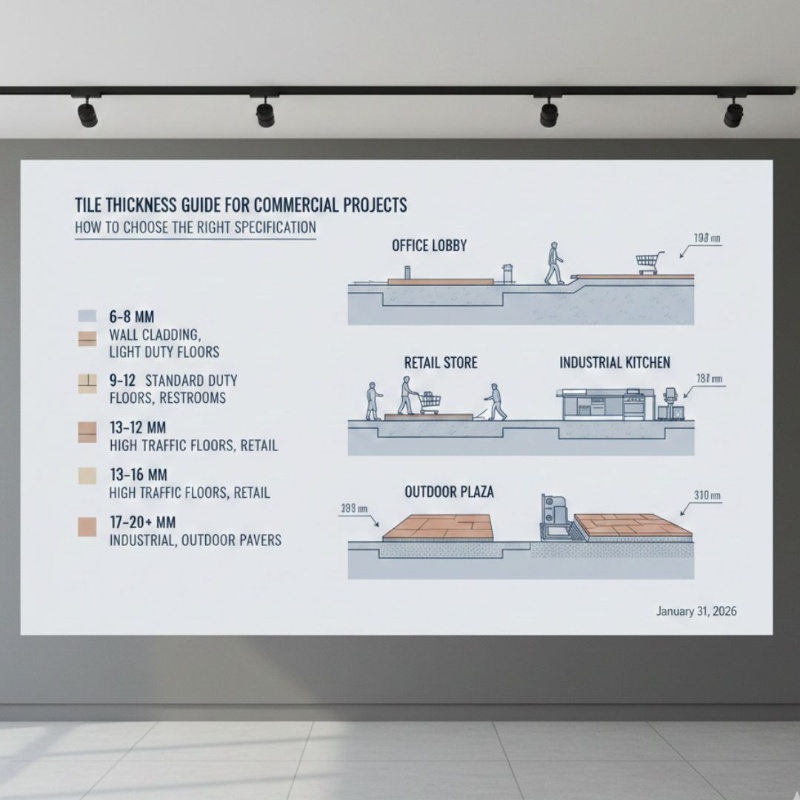







Tile Thickness Guide for Commercial Projects: How to Choose the Right Specification
Choosing the right tile thickness is one of the most critical technical decisions in commercial flooring and wall projects. While design, colour, and finish influence aesthetics, tile thickness directly impacts durability, structural performance, and long-term maintenance costs.
This tile thickness guide for commercial projects explains how thickness affects performance, which standards matter, and how to select the correct tile specification for different commercial environments such as offices, malls, hotels, hospitals, and retail spaces.
Industry Standards and Compliance for Commercial Tile Thickness
In commercial construction, tile thickness is often governed by project specifications, consultant approvals, and international standards. While thickness alone does not define quality, it plays a major role in compliance with:
- ISO 13006 (Ceramic tiles classification)
- EN 14411 (European tile standards)
- Project-specific BOQ requirements
Most large-scale developments in the UAE follow internationally recognised benchmarks to ensure tiles meet structural and safety expectations. Using thickness outside recommended ranges may result in non-compliance during project inspections.
This is another reason why a professional tile thickness guide for commercial projects is necessary during material specification and procurement.
Why Tile Thickness Matters in Commercial Projects
In commercial construction, tiles are exposed to significantly higher stress compared to residential settings. These spaces experience:
- Continuous foot traffic
- Heavy equipment movement
- Furniture load
- Trolleys and carts
- Frequent cleaning cycles
Tile thickness determines how well a tile can withstand these conditions without cracking, flexing, or failing over time. Selecting incorrect thickness can result in structural damage, surface wear, and costly replacements.
That is why a well-defined tile thickness guide for commercial projects is essential for architects, contractors, and project consultants.
Key Factors That Influence Tile Thickness Selection
Traffic Intensity
Areas such as shopping malls, airports, and commercial corridors require thicker tiles than office cabins or hotel rooms due to constant pedestrian flow.
Substrate Strength
The condition of the concrete slab or subfloor directly affects thickness requirements. Weaker substrates require thicker tiles for better stress distribution.
Tile Material Type
Porcelain tiles typically perform better at lower thickness than ceramic tiles due to higher density and lower porosity.
Installation Method
Raised flooring, dry installations, and outdoor applications require thicker tiles compared to adhesive installations.
Ideal Tile Thickness Commercial Applications
The ideal tile thickness commercial range depends on the project type:
| Application Area |
Recommended Thickness |
|
Offices |
8mm - 10mm |
|
Retail stores |
9mm - 11mm |
|
Shopping malls |
10mm - 12mm |
|
Hotels |
9mm - 11mm |
|
Hospitals |
10mm - 12mm |
|
Industrial areas |
12mm+ |
This reference framework supports most commercial use cases outlined in the professional tile thickness guide for commercial projects documentation.
9mm vs 12mm Tiles: Understanding the Difference
One of the most common questions in commercial tile selection is 9mm vs 12mm tiles.
9mm Tiles
- Suitable for moderate traffic
- Easier installation
- Lower material cost
- Ideal for offices, showrooms, and hotel rooms
12mm Tiles
- Higher structural strength
- Better resistance to impact
- Suitable for heavy traffic
- Recommended for malls, lobbies, and corridors
While 9mm tiles may appear sufficient, 12mm tiles provide better long-term durability in demanding commercial environments.
Installation Conditions That Affect Thickness Requirements
Adhesive Installation
Standard adhesive installations work well with 9mm -10mm tiles in moderate traffic areas.
Raised Flooring Systems
Raised flooring requires thicker tiles (10mm - 12mm) due to hollow support structures.
Outdoor Commercial Areas
External commercial zones require thicker tiles due to temperature variation and mechanical stress.
Installation conditions must always be evaluated alongside load capacity requirements.
Load Capacity and Structural Performance
Load capacity refers to the maximum stress a tile can handle without cracking or deforming. Tile thickness directly influences load-bearing ability.
Thicker tiles:
- Distribute stress more evenly
- Reduce point pressure
- Improve resistance to impact loads
- Lower breakage risk
In high-traffic commercial zones, tiles must support dynamic loads such as trolleys, carts, and furniture movement. This makes thickness a performance requirement rather than a design preference.
Tile Thickness vs Tile Size: What Designers Must Consider
Tile size and thickness must be evaluated together. Large-format tiles require greater thickness to maintain structural stability and prevent flexural stress.
For example:
|
SizeTile |
Recommended Thickness |
|
9mm – 10mm |
|
|
800×800 mm |
10mm – 11mm |
|
11mm – 12mm |
|
|
Slabs |
12mm+ |
Larger tiles with insufficient thickness are more prone to cracking during installation or under load, especially in commercial settings.
Benefits of Choosing Correct Tile Thickness
Improved Durability
Correct thickness prevents early failure, chipping, and surface damage.
Lower Maintenance Costs
Stronger tiles reduce repair frequency and replacement costs.
Structural Safety
Proper thickness ensures stability under continuous commercial use.
Better Long-Term ROI
Initial investment in thicker tiles results in lower lifecycle costs.
Common Mistakes in Commercial Tile Selection
Many project failures occur due to incorrect thickness selection. Typical mistakes include:
- Choosing tiles based on price only
- Using residential-grade thickness in commercial spaces
- Ignoring traffic load data
- Overlooking installation method requirements
A professional tile thickness guide for commercial projects eliminates these risks through proper technical evaluation.
How to Specify Tile Thickness for Commercial Projects
When specifying tiles, decision-makers should:
- Identify traffic category
- Review structural load requirements
- Select thickness based on usage
- Verify technical datasheets
- Match with installation system
This systematic approach ensures alignment with industry standards and performance expectations.
Why Thickness Is a Strategic Design Decision
Tile thickness impacts not just durability but also project compliance, safety, and sustainability. In modern commercial developments, tiles are expected to perform for decades without structural failure.
This makes tile thickness guide for commercial projects a critical reference for:
- Architects
- Developers
- Interior consultants
- Facility managers
Ignoring thickness during specification can compromise the entire flooring system.
Cost Implications of Tile Thickness
Thicker tiles typically cost more per square meter due to:
- Higher raw material usage
- Increased firing time
- Greater transport weight
However, lifecycle cost analysis shows that thicker tiles often reduce:
- Replacement frequency
- Maintenance costs
- Downtime in commercial spaces
For long-term projects, thicker tiles deliver better ROI despite slightly higher upfront investment.
Final Insights for Commercial Buyers
Selecting the correct tile thickness is not a cosmetic decision, it is a technical performance requirement. From ideal tile thickness commercial applications to understanding 9mm vs 12mm tiles and evaluating load capacity, thickness plays a defining role in project success.
For commercial developments seeking durable, high-performance tile solutions aligned with international standards, Volark Tiles offers technically engineered collections designed to meet real-world commercial demands. Their product specifications along with tile calculator support optimal thickness selection for both aesthetic excellence and structural reliability across hospitality, retail, healthcare, and large-scale infrastructure projects.
Frequently Asked Questions (FAQs)
1. Why is a tile thickness guide for commercial projects important?
A tile thickness guide for commercial projects helps architects and contractors select tiles that can handle traffic loads, structural stress, and long-term usage without failure or excessive maintenance.
2. What is the ideal tile thickness commercial buildings should follow?
The ideal tile thickness commercial range is typically between 9mm and 12mm, depending on traffic intensity, tile size, and installation method.
3. Which is better for commercial use: 9mm vs 12mm tiles?
When comparing 9mm vs 12mm tiles, 12mm tiles are more suitable for heavy-traffic areas, while 9mm tiles work well for moderate-use environments such as offices and hotel rooms.
4. How does load capacity relate to tile thickness?
Load capacity increases with tile thickness. Thicker tiles distribute pressure more evenly, reducing the risk of cracking, impact damage, and structural failure.
5. Can thinner tiles be used in commercial projects?
Thinner tiles may be used in low-traffic commercial zones, but high-traffic areas require thicker tiles to meet durability and safety standards.