

Wall Tiles for Living Room: What to Use, Where to Put It, and What to Avoid
Last month a customer walked into our Sharjah showroom with a photo on his phone. Living room in a villa somewhere in Al Barsha. Gorgeous furniture. Nice rug. Expensive-looking curtains. And behind it all? Plain white walls. Nothing. The room looked like it cost a fortune and still felt… empty.
He pointed at our 120×240 Statuario marble-look slab and said "that — on the TV wall." We installed it. Nine square metres of porcelain. One wall. He sent us photos after and the room looked like a different house. Same sofa. Same rug. Same curtains. But now the room had a centre of gravity. Something to look at. Something that pulled everything together.
That's what wall tiles do for a living room when you get it right. And that's what this guide is about — not theoretical interior design advice, but the actual decisions that work in real UAE homes. What tile. What wall. What finish. What to spend. What mistakes to dodge. Let's go.
Stop Painting Your Living Room Walls and Start Thinking Bigger
Here's a number that'll surprise you. Your living room walls have roughly three times the visible surface area of the floor. Three times. And what did you do with them? Jotun. Done.
Meanwhile you spent two weeks picking the perfect floor tile.
Look — paint is fine. For three walls out of four, paint is exactly the right answer. But that fourth wall? The one everyone faces when they sit down? The one behind the TV or the sofa or the fireplace? That wall deserves more. One tiled wall in a living room changes the whole room. Not a renovation. Not a project. One wall.
And in the UAE specifically, there's a practical argument on top of the design one. Paint in this climate lasts maybe 18 months before it starts showing marks. Scuffs behind the sofa. Yellowing near the kitchen if it's open-plan. AC condensation stains. Tile? Wipe it. Done. Twenty years and it looks the same.
Five Living Room Wall Tile Ideas That People Actually Use (Not Just Pin on Pinterest)
The Marble-Look TV Wall
This is what 70% of our living room wall tile customers end up choosing. And there's a reason for that — it works. Every single time.
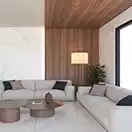
A large format porcelain slab — we're talking 60×120cm minimum, ideally 120×240cm — in a marble-effect finish. Calacatta if you want dramatic veining. Statuario if you want something softer and more classic. Grey-vein on white if you're going modern. Mount the TV on it. Add a floating shelf or a console below. That's it. The room is transformed.
Why it works in the UAE: porcelain doesn't react to humidity swings. It doesn't yellow from bakhoor or incense smoke — and if you've ever tried to get that out of painted walls, you know what I mean. It doesn't stain. It doesn't crack. And it doesn't need the annual sealing that real marble demands. You get the marble look without the marble headaches.
We carry these in multiple vein patterns and sizes at the Sharjah showroom. Bookmatched pairs available — two slabs that mirror each other like an open book. That's the one that really makes people stop and stare. Check the marble-look range here →
3D Textured Tiles Behind the Sofa
If marble isn't your thing — and honestly, not everyone wants the veiny stone look in their living room — textured tiles are the alternative that's been blowing up in 2026.
These are tiles with physical depth. Fluted ridges. Wave patterns. Geometric bumps. They're usually white or cream because the texture IS the design — you don't need colour competing with it. What makes them special is how they play with light. A wall-wash LED strip above a 3D fluted tile wall creates shadows that move as the sun moves. At noon the wall looks one way. At sunset it looks completely different. You don't get bored of it because it literally changes throughout the day.
I'll be honest about the downside though. The grooves collect dust. In Sharjah and Dubai where fine sand gets into everything, you'll notice it after a couple of weeks. Quick wipe with a microfibre cloth sorts it out, but if you're the kind of person who hates wiping walls, this isn't for you. Go with a flat marble slab instead.
We stock fluted, wave, and geometric 3D tiles in white and off-white at the showroom. Come see them under the spotlights — photos don't do them justice because the shadow effect is literally the whole point.
Stone-Look on the Fireplace Wall
Got a fireplace? Real one, electric one, ethanol one — doesn't matter. That wall around it is the natural place for tile. Always has been. Stone-look porcelain from floor to ceiling makes the fireplace feel monumental. Like it was always part of the architecture, not something that was added later.
Stacked ledger-stone effect for a rustic villa feel. Smooth travertine-look for something warmer and more Mediterranean. Or go full marble-effect if you want it sleek and modern. All of these are porcelain — meaning they're heat-safe, non-combustible, and don't need sealing.
A customer in Arabian Ranches did this last year — 120×240 grey limestone-look porcelain from floor to ceiling on the fireplace wall, with recessed niches on each side for firewood and decor. The living room went from builder-basic to magazine-worthy. One wall. About AED 3,000 all-in including installation.
Wood-Look Planks for a Warm, Panelled Feel
Not everyone wants stone or marble. Fair enough. Some living rooms need warmth. Softness. That cosy, "I could fall asleep on this sofa" vibe. And for that, wood-look porcelain planks on the wall are hard to beat.
Think of it like wood panelling, but porcelain. No warping from the AC. No termites. No expansion and contraction in summer. Just the visual warmth of timber grain on a surface that'll never give you problems.
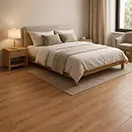
Install them vertically for height. Herringbone if you want a pattern. Horizontal for a more traditional panelled look. Light oak tones open the room up. Dark walnut tones make it feel intimate and grounded — great for a dedicated TV room or home cinema space.
Coordinate with your floor tiles — matching the wall planks to the floor creates flow. Contrasting them (dark wall, light floor) creates drama. Both work. Just don't accidentally mismatch where the tones clash instead of complementing.
Buy these at Volark: Multiple wood-look plank sizes and tones in stock. Works on both walls and floors. Browse the wood-look range →
A Patterned Tile Accent Strip (The Underrated Option)
Here's one you won't see on every blog because it's not as photogenic as a full marble wall. But it works beautifully in real homes.
Instead of tiling a full wall, tile a horizontal band at mid-height. Like a thick decorative stripe running across the wall. Below the band — paint. Above it — paint. The tile strip in between is the room's signature. Moroccan patterned tiles, geometric designs, even a simple contrasting colour band.
This is especially useful in open-plan spaces where the living room needs visual separation from the dining area or kitchen without building an actual wall. The tile strip acts as a design boundary. Subtle, practical, and different from what everyone else is doing.
Materials — What Works and What's a Waste of Money
| Material | Use It For | Skip It When | UAE Price |
|---|---|---|---|
| Porcelain | Everything. TV walls, fireplaces, panelling. | Never, really. It's the all-rounder. | AED 25–120/sqm |
| Ceramic | Budget projects, rental flats, light accents. | You want large format or high durability. | AED 12–55/sqm |
| Natural Stone | Luxury villas. Single statement walls. | You don't want to seal it every year. | AED 80–250+/sqm |
| Glass Mosaic | Tiny accent zones. Niches. Decorative inserts. | Covering any large area. Way too expensive per sqm. | AED 60–200/sqm |
| 3D / Textured | Feature walls with good lighting. | The wall doesn't have directional light on it. | AED 40–130/sqm |
The honest recommendation for 90% of UAE living rooms: porcelain. It does everything. Looks like marble, stone, wood, concrete — whatever finish you want. Doesn't need sealing. Handles the climate. Costs a fraction of natural stone. For the full breakdown on every material, our types of tiles explained guide goes deep. If you're specifically comparing ceramic and vitrified options, those guides have the detail.
Sizing — The One Decision That Changes Everything
Tile size on walls is more noticeable than on floors because the wall is at eye level. You see every grout line. You see every proportion. Wrong size on a wall looks off in a way that wrong size on a floor doesn't.
60×120cm — the current sweet spot. Big enough to look modern and seamless. Not so big that you need a specialist crew to install it. This is what most of our living room wall tile projects use right now.
120×240cm — the statement size. One slab covers a massive area. Almost no grout lines. Looks like a solid stone panel. But it's heavy, it needs perfect substrate, and installation costs more. Worth it on a TV wall or fireplace where you want the wow factor.
30×60cm and smaller — fine for accents and patterns, but don't cover an entire living room feature wall in small tiles. Too many grout lines. Looks busy. Takes the room backward instead of forward.
Which Wall to Tile (And Which to Leave Alone)
People overthink this. It's almost always one of three options:
The TV wall. First choice, 70% of the time. Everyone faces it. The TV needs a backdrop. Tile gives it one.
The wall behind the main sofa. Second choice. Guests face it. Textured tiles here add depth that paint can't match.
The fireplace wall. If you have one, this is a no-brainer. Floor-to-ceiling tile makes the fireplace the centrepiece it's supposed to be.
Don't tile: the wall full of windows (awkward cuts around frames), the wall with three doors and a hallway entrance (too many interruptions), or all four walls (unless you're building a hotel lobby, and you're not).
The Mistakes. We've Seen All of Them.
Glossy tile on a sun-facing wall. Customer in JLT. Beautiful polished porcelain on the wall facing the floor-to-ceiling windows. Afternoon sun turned the room into a greenhouse of reflected glare. He couldn't sit on the sofa after 3pm without squinting. They came back and swapped it for matte. Lesson: if the wall catches sunlight, go matte. Always.
Cheap adhesive on heavy slabs. This one makes us angry because it's entirely the installer's fault. Large format porcelain on walls needs C2 class adhesive with extended open time. Not the basic grey stuff from the hardware store. We had a case where a 120×240 slab fell off a wall in Al Nahda three months after installation. Nobody was standing near it, thank God. But it hit the TV console on the way down. The installer used standard floor adhesive. On a wall. With a 25kg slab. Criminal.
No lighting on textured tiles. 3D tiles without wall-wash lighting look like plain tiles that cost twice as much. The entire point of texture is shadow play. No directional light = no shadows = no point. Plan your lighting before you tile, not after.
Four walls of tile. We actively talk customers out of this. One lady wanted her entire living room in marble-look porcelain — all four walls, floor to ceiling. We showed her what that looks like at room scale in our showroom display. She changed her mind in about 15 seconds. One wall. That's the move.
Not coordinating wall and floor. Your wall tile doesn't need to match your floor tile. But they need to be friends. Warm wall + cool floor = disconnected. Bring both samples home and lay them next to each other under your actual room light. If they clash, one of them needs to change. Our living room floor tiles guide covers how to match wall and floor choices without making the room feel "matchy-matchy."
What It Actually Costs
Let's talk real numbers. A single feature wall in a living room — let's say 3 metres wide, 3 metres high, so 9 square metres:
| Option | Tile Cost | Installation | Total |
|---|---|---|---|
| Budget ceramic (30×60) | ~AED 350 | ~AED 450 | ~AED 800 |
| Mid-range porcelain (60×120) | ~AED 700 | ~AED 550 | ~AED 1,250 |
| Premium marble-look slab (120×240) | ~AED 1,200 | ~AED 700 | ~AED 1,900 |
| 3D textured porcelain | ~AED 900 | ~AED 550 | ~AED 1,450 |
| Natural stone | ~AED 1,800 | ~AED 800 | ~AED 2,600 |
That's for one wall. 9 square metres. Most people are genuinely surprised that a mid-range feature wall costs about AED 1,200 — less than a decent sofa. For the impact it makes, it's one of the best-value upgrades you can do in a living room.
Get your quote: WhatsApp us or walk into the Sharjah showroom. We'll price it out for your exact wall dimensions on the spot.
Where to Buy — Honestly
Dragon Mart. You'll find tiles there. Cheap ones. Quality is inconsistent and nobody's giving you design advice. If you know exactly what you want and you're just price shopping, fine.
Danube Home, ACE, big-box stores. Mid-range. Decent selection. But the displays are generic and the staff aren't tile specialists — they're retail staff covering 15 departments.
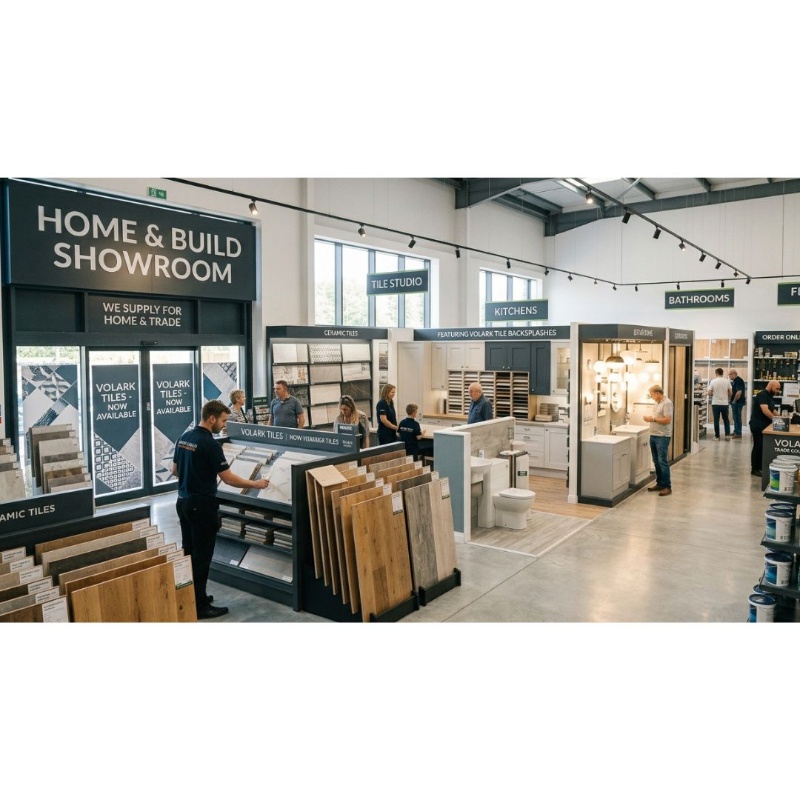
Then there are showrooms like ours. At Volark Tiles in Sharjah, wall tiles are displayed as actual wall installations. Not sample chips. Not catalogue pages. Real walls, tiled at full scale, with proper lighting, so you can stand in front of them and see the finished effect before you commit. That's the difference.
We carry porcelain, ceramic, marble-effect, wood-look, 3D textured, and large format wall tiles. Sizes from small accents to 120×240cm slabs. We work with everyone — families doing one feature wall, interior designers doing full villa fitouts, contractors doing apartment blocks. We're a tiles supplier across Dubai and all the Emirates, and we deliver on schedule.
Start here: volarktiles.com to browse. WhatsApp for samples and prices. Or just drive over — Maleha Street, Industrial Area, Sharjah. Parking at the door.
Questions People Actually Ask Us
What's the best wall tile for a living room in the UAE?
Porcelain. Marble-effect or stone-look, 60×120cm or larger, matte finish. Handles the humidity, the AC cycling, the dust, the incense smoke, the kids. Doesn't need sealing. Doesn't need repainting. Wipes clean. Done for 20 years.
Should I tile one wall or the whole room?
One wall. The TV wall, the sofa wall, or the fireplace wall. The contrast between the tiled wall and the three painted walls is what makes it look designed. Tile everything and the room becomes a cold box. We've talked more customers out of all-four-walls than into it.
Will tiles make my living room feel cold?
Only if you pick the wrong ones and go overboard. A warm-toned stone or wood-look tile on one wall? Cosy. Cool grey marble on all four walls? Hospital. The trick is restraint plus the right colour temperature. Warmer tones, less coverage. That's the formula.
What size tile for a living room wall?
60×120cm for most projects. Modern enough, big enough to reduce grout, not so big that installation costs skyrocket. If the wall is a major feature and you want maximum drama — 120×240cm slabs. Avoid small tiles on feature walls. Too many lines. Looks cluttered.
Can I use floor tiles on my wall?
Yes. Floor tiles are heavier and denser than wall tiles, but they work perfectly on walls. Some of our best living room wall installations use floor-rated porcelain. Just make sure the adhesive is rated for the weight. Standard wall tile adhesive won't hold a 25kg floor slab on a vertical surface.
How do I match wall tiles with my floor?
Don't match. Coordinate. Same colour family — warm with warm, cool with cool. Or deliberate contrast — dark floor, light wall. What kills the room is accidental mismatch. Beige wall next to grey floor with no connecting element between them. Bring samples of both home. Look at them together. Under your light. At different times of day. If they look like they belong in the same room, you're good.
Are wall tiles hard to clean?
Easier than paint. Porcelain and glazed ceramic — damp cloth. Fingerprints, dust, cooking residue, incense film — all wipe off instantly. The only exception is 3D textured tiles where dust sits in the grooves, but that's a 30-second job with a microfibre cloth. Less maintenance than repainting your walls every 18 months, guaranteed.
How much does one feature wall cost?
A 3×3m wall (9 sqm) in mid-range porcelain: roughly AED 1,200–1,500 all-in with installation. Premium large-format slabs: AED 1,800–2,500. Budget ceramic: under AED 900. Less than a sofa. More impact than anything else you could do to the room for that money.
Do I need special lighting for wall tiles?
For flat tiles — no. Standard ceiling lights work fine. For 3D or textured tiles — absolutely yes. You need wall-wash lighting. Recessed downlights angled at the wall, or an LED strip at the top. Without directional light, the texture disappears. The tiles look flat. The premium you paid for the 3D effect is wasted. Plan the light before you tile.
Where can I see living room wall tiles in the UAE?
Volark Tiles showroom, Sharjah. Full-scale wall installations. Not sample squares — actual walls. Bring your floor tile sample and your paint reference. We'll help you put it all together. Walk-ins welcome. We cover Dubai, Abu Dhabi, Ajman, Ras Al Khaimah, and everywhere in between.