What Are the Best Small Kitchen Tile Ideas to Maximize Style and Space ?

Small kitchens can be adorable. They're cozy, efficient, and filled with personality. But when you're designing, a small kitchen needs clever choices to be spacious, inviting, and practical. One of the simplest but most effective upgrades? Tiles.


This guide covers 15 small kitchen tile ideas — from floors to backsplashes — with honest advice on what works, what to avoid, and how to think about the design as a whole. Tiles not only protect your walls and floors from the rigors of everyday wear and tear, they bring color, texture, and style to your kitchen space. Whether you're searching for small kitchen tile ideas for your floor or shopping small kitchen backsplash tile ideas, the right design can make your space look instantly improved.
In this guide, we address the most common questions from homeowners if they are planning a tile makeover of their small kitchen.


Key Takeaways

   Small kitchen tile ideas can transform your area to make it brighter, more spacious, and more fashionable.
· The 15 ideas below cover every area: floor, backsplash, and full-wall treatments.
· Floor and backsplash tile coordinating gives a clean, uniform appearance.
· Long-term durability and beauty come from quality tiles.In hot climates like the UAE, porcelain tiles are the most practical choice for kitchen floors.
· Regular cleaning makes your kitchen smell fresh. Coordinating floor and backsplash tiles gives a cohesive, spacious look with minimal effort.


15 Small Kitchen Tile Ideas 


Floor Tiles

01. Large Format Tiles — 600×1200mm or Bigger


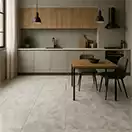
The logic is simple: fewer grout lines means the floor reads as one continuous surface rather than a grid. A 600×1200mm tile on a small kitchen floor does more for the perception of space than almost any other single decision. Light grey or warm beige in a polished or semi-polished finish is the combination that works most consistently.
One note: this only works when the installation is clean. Misaligned large format tiles look worse than small tiles would. Get a good tiler.


02. Herringbone Pattern, Neutral Colour

A herringbone floor in a neutral colour is honestly one of the more underappreciated options for a small kitchen. It looks busy in a showroom, but in an actual kitchen — with units on both sides and a worktop running across — it just looks good. The pattern gives the floor some life without you having to commit to a colour you might hate in five years. A 75×300mm or 100×300mm tile in off-white or light stone is where most people end up, and it works.
The diagonal lines do something useful in a narrow kitchen — instead of the eye hitting the opposite wall and stopping, it follows the pattern sideways, which makes the room feel slightly wider than it is. Grout colour matters here. Go more than two shades away from the tile and it stops being a herringbone floor and starts looking like a net.


03. Checkerboard Floor

Classic for a reason. Black and white checkerboard has been in kitchens since at least the 1920s and it still works because it creates a defined zone — the kitchen becomes its own space visually, even if it's part of an open plan. In a small kitchen, go with 200×200mm squares rather than larger. And install them at 45 degrees. A diagonal checkerboard reads wider than one that runs parallel to the walls.


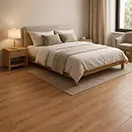
04. Wood-Look Porcelain Planks

Wood-look porcelain has gotten very good in the last few years. The better versions — particularly the 150×900mm and 200×1200mm formats — are genuinely hard to distinguish from real timber unless you're on your hands and knees. And unlike real wood, they don't swell in humidity, don't scratch badly, and clean up properly after a cooking session.
In the UAE specifically, wood-look porcelain makes more sense than timber in a kitchen. The combination of air conditioning cycling on and off and the cooking humidity isn't kind to real wood over time. Porcelain handles it without complaint.
Lay them lengthwise — parallel to the longest wall — to make the room feel longer.


05. Tonal Mosaic Floor

Mosaics are tricky in a small kitchen. Done wrong, they turn the floor into wallpaper — too much going on, too many edges, too much grout catching dirt. Done right, they add a texture and warmth that no large format tile can match. The difference is usually colour discipline. Stay inside one tonal family — all soft whites, all warm greys, all sandy creams — and the mosaic reads as texture rather than pattern. Start mixing in contrasting colours and you'll regret it within a month. The floor competes with everything else and wins, which is never what you want in a small kitchen.


 Small Kitchen Backsplash Tile Ideas


06. Glossy White Subway Tile

There's a reason glossy white subway tiles have been in kitchens since the early 1900s and still don't look tired. They're not fashionable in a way that dates — they're just correct for the job. White reflects light back into the room. The gloss amplifies that. The horizontal format works with most ceiling heights. And when something goes wrong — a chip, a cracked tile, a grout line that goes dark — you can replace one tile without the whole wall looking patched.
Format-wise, 75×300mm is what most people picture when they think subway tile. It's the classic. The 100×300mm is slightly chunkier and feels more current — better in kitchens with higher ceilings and more modern unit fronts. If the kitchen ceiling is low and you want to push it up visually, stack the tiles vertically instead of horizontally. It's a small change that works better than most people expect.


07. Full-Height Backsplash

Taking tiles all the way to the ceiling is one of those things that sounds expensive but usually isn't — you're just buying more of the same tile. The visual effect is significant. An unbroken vertical surface makes the kitchen feel taller and more resolved. It also removes the visual interruption of a painted wall section above the tiles, which in a small kitchen tends to make the space feel chopped up.
Works best with a simple tile. The point is the height, not the tile itself.


08. One Patterned Feature Wall

Four patterned walls in a small kitchen is too much. One is just right. The wall behind the hob or the sink is the obvious choice — it's what you look at most and it's already framed by the units on either side. Put something with real character there: a geometric repeat, something Moroccan-inspired, old-school terracotta. The rest of the walls stay plain. That contrast is what turns a patterned tile into a design decision rather than a panic buy.
The plain surroundings are doing most of the work. Put a busy patterned tile next to loud unit fronts and open shelving stacked with colourful things, and the pattern just adds to the noise. Give it a plain white tile on either side and a neutral floor underneath, and suddenly it looks like you planned it.


09. Large Format Slab Backsplash

Large format slabs on the backsplash have become more common over the last few years, and it makes sense — the fewer grout lines you have on a kitchen wall, the easier it is to keep clean and the more seamless the whole thing looks. A 600×1200mm or 800×1600mm slab in marble-effect or concrete-look porcelain gives you the kind of wall that looks like it cost significantly more than it did. There's also a practical reason to consider it: one large tile is one large surface to wipe down, not a grid of small tiles with grout channels running between every one of them.
If you want the backsplash to tie in with the worktop material — same stone effect, same colour family — the large format slab is the best way to do it. The visual line between worktop and wall blurs in a way that makes the whole kitchen look more put together. Small tiles with visible grout lines behind a continuous worktop always looks slightly disjointed by comparison.


10. Textured 3D Relief Tiles


Most small kitchen guides focus on colour as the main variable for backsplash tiles. But if the kitchen doesn't get much natural light, colour alone won't fix it — a flat white matte tile in a dark kitchen is still a dark kitchen. A textured or relief tile does something different: it catches and scatters light rather than reflecting it back flat. At different times of day the same tile looks different, which sounds minor but makes a real difference to how static or alive the kitchen feels. It's also the better choice if you don't want the backsplash to draw attention away from anything else in the space.
Colour-wise, keep it to whites, light greys, or warm off-whites. A textured tile in a dark or saturated colour starts to feel oppressive in a small space — the texture adds weight along with depth. Let the three-dimensional surface do the design work and give it a quiet colour to do it in.


11. Metallic or Iridescent Tiles


Gold and copper tiles get a bad reputation because people use too many of them. A full backsplash in metallic tile looks like a disco ceiling, not a kitchen. But an accent strip — three rows of copper between plain subway tiles, or alternating metallic and white — does something genuinely useful in a small kitchen that's short on natural light. The reflective surface scatters light in a way that flat tiles don't. The kitchen feels brighter without you having to source a skylight. Use them sparingly and the effect is good. Cover the whole wall and it'll be the first thing you want to rip out.


12. Warm Terracotta or Handmade-Look Ceramic


Terracotta and handmade-look ceramic tiles are for kitchens that don't want to look like a hotel. The colour shifts slightly across tiles. The edges aren't perfectly straight. The surface has a bit of variation to it. On paper that sounds like a flaw — in practice it's what makes the kitchen feel like someone actually chose it rather than just ticked a box. If the rest of the home runs warm — timber, rattan, linen, anything that isn't gloss white and brushed steel — this is the backsplash that fits without you having to force it.
What doesn't work with this tile: chrome taps, white gloss units, LED strip lighting, anything clinical. What does: open timber shelving, cream or sage units, a single brass tap, natural light. The tile on its own is just a tile. In the right context it pulls the whole kitchen together in a way that's very hard to achieve with a standard porcelain.

Floor and Backsplash Together


13. Match the Grout, Not the Tile


This one's underrated. If you're using different tiles on the floor and backsplash — which is fine — use the same grout colour throughout. Light grey works across most combinations. It creates a visual thread that ties different surfaces together without requiring matching tiles. The kitchen looks more cohesive without any additional effort or cost.

14. Same Tile, Different Orientation


This one sounds like a designer trick but it's actually just practical. Buy one tile. Use it everywhere. Lay it horizontally on the floor and vertically on the backsplash — or diagonal down below and straight up above. The material is the same so nothing clashes, but the different directions mean the floor and wall each have their own thing going on. It saves you the decision of which two tiles go together, which is genuinely one of the harder parts of tiling a kitchen. Works best with simpler formats — 100×300mm, 150×150mm — where the direction change is obvious.


15. Tone-on-Tone Layering


Most people overthink the floor-backsplash combination and end up with two tiles that technically go together but don't feel like they belong to the same kitchen. Tone-on-tone sidesteps that entirely. You pick a colour — warm greige, cool grey, whatever fits the light in the room — and you commit to it across every surface. The floor can be matte large format. The backsplash can be glossy subway. There might be a slightly textured border tile in between. Everything is a different material and finish, but they're all singing in the same key. It photographs well. It ages well. And it avoids the thing that makes small kitchens feel cramped more than anything else — too many competing surfaces all visible at the same time.

Why Tiles Are a Smart Choice for Small Kitchens

1.Visual Impact in Small Spaces: Tiles can instantly define the look of your kitchen, ranging from gleaming, reflective finishes to patterned motifs that make a bold statement.
2. Easy Maintenance: The kitchen is a dirty business,
and kitchen tiles make it a snap to clean. . An easy wipe-down keeps them appearing fresh.
3. Unlimited Design Choices: Because there are unlimited sizes, colors, and textures to choose from, you can create a space that is an authentic expression of your personality.
Volark Tiles has collections that range from minimalist and contemporary to rough and textured, so you have plenty of choices to match your style. Leverage our Tiles Calculator to know how much it will cost for your small kitchen. 


4. Long-Term Durability: Small kitchens are subject to heavy usage in a small area. Well-made tiles are able to tolerate spills, foot traffic, and heat without losing their attractiveness.

Kitchen Tiles

What Are the Most Popular Small Kitchen Backsplash Tile Ideas?
 

Your backsplash has a function as well as an aesthetic role. In a tiny kitchen, it's also a means of adding personality without taking up space.
Best backsplash ideas:
1. Glossy Subway Tiles—Timeless and shiny, making the kitchen appear brighter.
2. Bold Patterned Tiles—Geometric prints or Moroccan-inspired designs create a focal point.
3. Metallic Accents—Gold, copper, or silver accents give understated luxury.
4. Full-Height Backsplash—Bringing tiles up to the ceiling stretches walls optically.


How Do I Mix Floor and Backsplash Tiles in a Small Kitchen?

A coordinated floor and backsplash create a uniform, refined look.

Design pairing ideas:

Floor Style
 
Backsplash Style Result
Neutral Floor Bold Patterned Backsplash Keeps the base calm while highlighting the upper wall.
Patterned Floor Simple Backsplash Adds interest underfoot without overwhelming the space.
Same Tile for Both Matching seamless design Ideal for minimal, modern kitchens.

How Can Tiles Make My Small Kitchen Look Bigger?

Choosing the right tiles can dramatically change how spacious your kitchen feels. Tiles that make small kitchens look bigger typically share a few visual characteristics: light tones, minimal grout lines, and reflective finishes. 
 

The following are helpful tips on opening up your space visually:

· Go Vertical: Position rectangular tiles vertically on walls to guide the eye upward.

· Apply Glossy Finishes: to bounce light and add brightness and depth.

· Select Grout Carefully: Use light grout with light tiles to blend in for a streamlined appearance.

· Limit the Color Palette: Less color contrast avoids a cluttered look.

Small Kitchen Tiles Ideas

What Are the Advantages of Choosing Quality Tiles for a Small Kitchen?

When working with a small footprint, every design choice counts and quality is non-negotiable.
High-quality tiles offer:
· High-Definition Printing – Realistic stone, wood, or patterned effects.
·  Durable Finishes – Scratch-resistant and easy to clean.
·  Eco-Friendly Production – Green materials and processes.
·  Design Scope—From quiet neutrals to bold statement tiles.


How Do I Maintain My Small Kitchen Tiles?

Maintaining tiles in a small space is easier than you might think:

Task Frequency Benefit
Sweep or Vacuum Daily Prevents dirt buildup in a concentrated space.
Wipe Spills Immediately As needed Avoids stains and keeps grout clean.
Reseal Grout Yearly Protects against moisture and discoloration.
Use Mild Cleaners Always Preserves tile finish and shine.


Chat with us on WhatsApp